If your packaging portfolio includes anything coloured in deep black, dark grey, or very dark brown, there is a good chance it contains carbon black pigment. And if it does, that single ingredient could be costing you thousands of pounds a year in inflated EPR fees — a figure set to double by 2028-2029 under fee modulation. The frustrating part is that the fix is neither expensive nor technically difficult. Most producers simply have not been told there is a problem, let alone that there are readily available solutions.
This article explains what carbon black is, why it triggers an automatic Red RAM rating, what alternative pigments exist, how much the switch actually costs, and how to manage the transition without disrupting your supply chain.
What Is Carbon Black and Why Is It Everywhere?
Carbon black is a fine powder produced by the incomplete combustion of hydrocarbons — petroleum products, coal tar, or natural gas. It has been the default dark pigment in the plastics industry for decades because it is cheap, effective, and versatile. It provides deep, uniform black colouration at low loading rates, offers UV protection that extends shelf life for light-sensitive products, and is compatible with virtually every common packaging polymer: PET, HDPE, PP, PS, and more.
You will find carbon black in food trays (particularly ready meal trays), cosmetics packaging, electronics accessories, click-and-collect tote boxes, plant pots, and a wide range of industrial containers. In the UK packaging market alone, it is estimated that over 60,000 tonnes of carbon black plastic packaging enters the household waste stream every year.
For many years, there was no commercial reason to question its use. It did what it was supposed to do, and nobody asked questions about what happened when the packaging reached a materials recovery facility (MRF). That changed when the UK introduced the Recyclability Assessment Methodology.
Why Carbon Black Causes Red RAM Ratings
The RAM assesses packaging recyclability across five stages: Classification, Collection, Sortation, Reprocessing, and End Market Application. Carbon black creates a hard failure at Stage 3: Sortation.
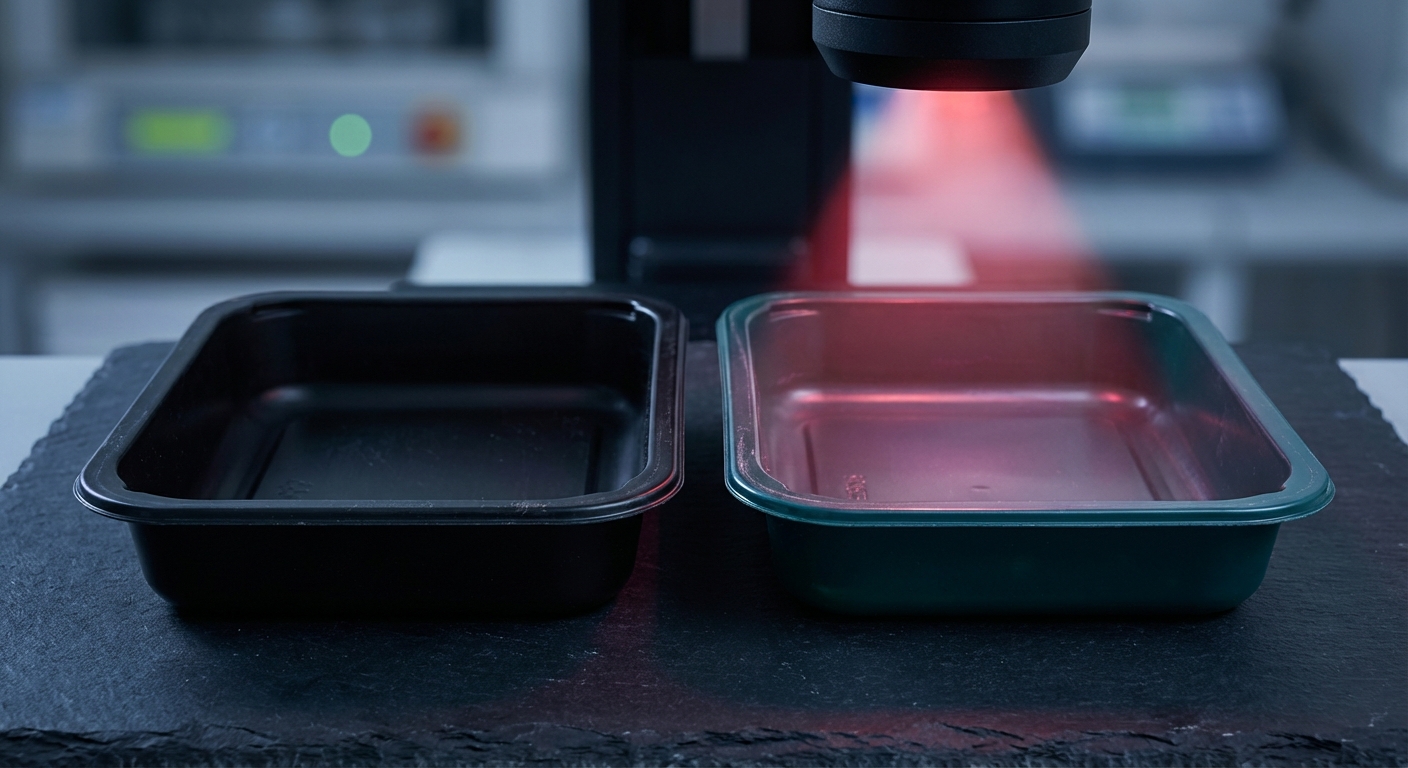
Here is the technical explanation. When mixed plastics arrive at a MRF, the facility uses near-infrared (NIR) spectroscopy to identify and separate different polymer types. NIR sensors emit infrared light towards the conveyor belt. Each polymer type reflects a unique spectral signature back to the detector, allowing the system to classify items as PET, HDPE, PP, PS, and so on, and direct them to the correct output stream using air jets.
Carbon black absorbs near-infrared radiation almost completely. Rather than reflecting a readable spectral signature, a carbon black item absorbs the light and returns nothing to the sensor. To the NIR system, the item is invisible. It is as if the packaging does not exist on the belt.
When a MRF cannot identify a piece of packaging, it falls through to the residual waste stream. It does not get sorted, does not get recycled, and ends up in landfill or energy-from-waste incineration regardless of whether the underlying polymer is perfectly recyclable. A clear PET tray and a carbon black PET tray may be chemically identical polymers, but only one of them will ever reach a reprocessor.
Carbon black packaging is not unrecyclable because of its material. It is unrecyclable because sorting infrastructure cannot see it. That distinction matters, because it means the problem is solvable without changing your polymer.
Under the RAM framework, any packaging component that fails Sortation due to NIR invisibility receives a Red rating. There is no partial credit. There is no Amber pathway for carbon black. The result is binary: if the pigment absorbs NIR, the packaging is Red.
The Cost Impact Under Fee Modulation
A Red RAM rating does not just appear on a compliance report. From the 2026-2027 compliance year onwards, it directly inflates the EPR fee you pay for that packaging component. The modulation schedule is clear:
| Compliance Year | Modulation Factor (Red vs Green) | Extra Cost on 100t of Packaging |
|---|---|---|
| 2025-2026 | 1.0x (no modulation) | £0 — flat fees |
| 2026-2027 | 1.2x | ~£5,000 extra vs Green |
| 2027-2028 | 1.6x | ~£15,000 extra vs Green |
| 2028-2029 | 2.0x | ~£25,000 extra vs Green |
The cumulative impact is striking. A producer placing 100 tonnes of carbon black plastic packaging on the UK market would pay approximately £45,000 more than necessary across the three modulated years compared to using a detectable pigment alternative. For producers handling larger volumes, the figures scale linearly. A 500-tonne portfolio of carbon black packaging could face a quarter of a million pounds in avoidable fees over the same period.
And this is purely the EPR fee impact. It does not include the growing commercial pressure from retailers who are setting their own packaging recyclability standards, or the reputational cost of being identified as a producer whose packaging cannot be recycled.
Alternative Pigment Technologies That Solve the Problem
The good news is that the packaging industry has already developed several alternatives to carbon black that produce dark colouration while remaining detectable by NIR sorting equipment. These are not experimental technologies. They are commercially available, proven in production, and used by major brands and retailers across the UK and Europe.
NIR-Detectable Black Masterbatch
The most direct replacement is a near-infrared detectable black masterbatch. These formulations use proprietary pigment blends — typically combinations of organic pigments and inorganic colorants — that produce a visually dark appearance while reflecting enough NIR energy for MRF sorting equipment to read the polymer signature.
To the human eye, packaging coloured with detectable black masterbatch looks identical or very close to traditional carbon black. Side-by-side, most consumers and even industry professionals cannot distinguish between the two. Under an NIR sensor, however, the difference is dramatic: the detectable version returns a clear polymer identification signal.
Major masterbatch suppliers now offer detectable black options across all common packaging polymers. Leading suppliers include Colour Tone Masterbatch, Ampacet, Clariant, and BASF, among others. Product lines such as Ampacet's "NIR-D" range and Clariant's "CESA-IR" series are specifically engineered for this application.
Dark Non-Black Colourways
Another approach is to move away from true black entirely and adopt very dark alternative colours that achieve a premium appearance without any carbon black content. Deep navy, dark forest green, charcoal grey, and dark plum are all achievable with standard organic pigments that are fully NIR-transparent.
This approach has been embraced by several major UK retailers for their own-brand packaging. The visual impact on shelf is minimal — consumers respond to dark, premium-looking packaging regardless of whether it is technically black or very dark blue — while the recyclability outcome is transformed from Red to Green.
Unpigmented or Naturally Coloured Alternatives
For some applications, the most cost-effective solution is to eliminate dark pigment entirely. Clear PET trays, natural-coloured HDPE, and translucent PP containers are the most recyclable options available and attract the lowest possible EPR fees. Where the dark colour was originally chosen for aesthetic reasons rather than functional necessity, removing the pigment altogether can save both the masterbatch cost and the EPR fee premium simultaneously.
The Best Alternative Depends on Your Polymer
Not every detectable masterbatch works with every polymer at every processing temperature. Always request an NIR test report from your masterbatch supplier confirming detectability in your specific polymer and application. Repackd's material database includes NIR detectability data for common packaging formats to help you screen options before engaging suppliers.
Real-World Examples of Successful Switches
The shift away from carbon black is not theoretical. It has been happening across the UK packaging market for several years, accelerated first by retailer pressure and now by EPR fee modulation. Here are three representative examples.
Ready Meal Trays: PET with Detectable Masterbatch
One of the largest categories of carbon black packaging in the UK has historically been black PET ready meal trays. Several major food manufacturers have switched to detectable black PET masterbatch across their entire tray range. The trays look the same on shelf, perform identically in production (same thermoforming parameters, same seal integrity), and achieve Green RAM ratings instead of Red. The masterbatch cost premium was approximately 8-12% on the pigment line item, but the EPR fee saving far exceeded this. One producer reported a net annual saving of over £40,000 after accounting for the higher masterbatch cost.
Cosmetics Packaging: Switch to Dark Navy PP
A premium skincare brand moved its entire range of PP jars and caps from carbon black to a very dark navy blue. The colour was chosen through consumer testing that confirmed no negative perception impact. The brand maintained its premium shelf appearance while moving from Red to Green on all affected components. The pigment cost was actually lower than carbon black because standard organic blue pigments are less expensive at the loadings required for very dark shades.
Click-and-Collect Crates: Switch to Dark Grey HDPE
A national grocery retailer replaced its carbon black HDPE click-and-collect crates with a detectable dark grey formulation. The crates, which cycle through hundreds of uses before end-of-life, now enter the recyclable stream when retired instead of being sent to energy recovery. While the transit packaging EPR fees for these items are modest per unit, the fleet volume made the switch worthwhile and aligned with the retailer's published sustainability commitments.
Find out which of your packaging uses carbon black
Upload your packaging data and Repackd will flag every component at risk of NIR detection failure, with specific alternative recommendations and fee savings projections.
Cost Comparison: Carbon Black vs Detectable Alternatives
The most common objection to switching away from carbon black is cost. Let us address this directly with real market data.
| Cost Factor | Carbon Black Masterbatch | NIR-Detectable Black Masterbatch |
|---|---|---|
| Masterbatch price (per kg) | £2.50 – £3.50 | £3.00 – £4.50 |
| Typical loading rate | 2-3% | 2-4% |
| Cost per tonne of packaging | £50 – £105 | £60 – £180 |
| EPR fee (2028-2029, per tonne) | £500 (Red, 2x multiplier) | £250 (Green, base rate) |
| Total cost per tonne (material + fee) | £550 – £605 | £310 – £430 |
The numbers are unambiguous. Even in the worst case scenario — the most expensive detectable masterbatch at the highest loading rate — the total cost is still lower than using cheap carbon black once you account for EPR fees. The masterbatch premium is between £10 and £75 per tonne. The EPR fee saving is £250 per tonne at the 2.0x multiplier. The return on switching is immediate and substantial.
For dark non-black alternatives (navy, charcoal, dark green), the economics are even more favourable because standard organic pigments are often cheaper than both carbon black and detectable black formulations.
Testing Your Packaging for NIR Detectability
If you are unsure whether your current dark packaging uses carbon black or an alternative pigment, there are several ways to find out.
Ask Your Supplier
The simplest approach is to request a material data sheet or pigment declaration from your packaging supplier or masterbatch compounder. Any reputable supplier will be able to confirm whether the formulation contains carbon black and, if not, provide NIR detection test data. If your supplier cannot answer this question, that is a red flag in itself.
Conduct an NIR Detection Test
Several UK-based testing laboratories offer NIR sortability testing for packaging materials. The test involves passing sample items through a bench-top or full-scale NIR sorting system and measuring whether the polymer is correctly identified. WRAP has published guidance on testing protocols, and labs such as Nextek, Smithers, and Intertek all offer this service. Typical turnaround is one to two weeks with costs ranging from £200 to £500 per sample set.
Use the OPRL Recyclability Assessment
If your packaging carries an On-Pack Recycling Label (OPRL), the OPRL assessment process will have already evaluated NIR detectability as part of the sortation criteria. Packaging that was downgraded or rejected by OPRL on sortation grounds almost certainly contains carbon black or another NIR-absorbing pigment.
Visual Inspection (Rough Guide)
As a rough preliminary screen, hold the packaging up to a strong light source. Carbon black packaging will appear completely opaque with no light transmission whatsoever, even at thin wall sections. Some detectable alternatives allow a faint hint of colour (dark red, dark blue) to show through when backlit. This is not a definitive test, but it can help prioritise which items to send for formal NIR testing.
A Practical Timeline for Making the Switch
Changing a packaging specification is not instant, but it does not need to take years either. Here is a realistic timeline for a typical switch from carbon black to a detectable alternative.
Weeks 1-2: Audit and Prioritise
Identify every dark-coloured packaging component in your portfolio. Confirm which ones use carbon black. Rank them by tonnage to prioritise the highest-impact items first. This step alone can be completed using Repackd's RAM assessment tool, which flags carbon black risk automatically based on your packaging data.
Weeks 3-4: Supplier Engagement
Contact your packaging supplier or masterbatch compounder to discuss detectable alternatives. Request samples and technical data sheets. Most suppliers can provide samples within a week, and many carry detectable black grades as standard stock items.
Weeks 5-8: Production Trials
Run small-scale production trials with the alternative masterbatch. Evaluate colour consistency, processing behaviour (melt flow, cycle time), mechanical performance, and visual appearance. In most cases, detectable black masterbatch is a drop-in replacement requiring no tooling changes and minimal process adjustment.
Weeks 9-10: NIR Verification
Send trial samples for NIR detection testing to confirm sortability. This step provides the documented evidence you need to update your RAM assessment from Red to Green.
Weeks 11-16: Rollout
Phase the new masterbatch into full production. Coordinate with your supply chain to manage any overlap period with existing carbon black stock. Update your packaging specifications, supplier agreements, and compliance records.
Total Timeline: 3-4 Months
A typical carbon black switch can be completed in 12-16 weeks from initial audit to full production rollout. If you start in Q1 2026, you can have detectable packaging in place well before the 2026-2027 modulated fee period begins. Waiting costs money. Every month of delay with Red-rated packaging is an avoidable expense.
Beyond Pigment: Other Sortation Barriers to Watch
While carbon black is the most common cause of NIR sortation failure, it is not the only one. As you audit your packaging, watch for these related issues that can also trigger Red ratings:
- Full-body shrink sleeves on bottles and containers can mask the underlying polymer, preventing NIR identification even when the base material is perfectly recyclable.
- Multi-layer laminates with different polymers in each layer confuse NIR systems that read only the outer surface material.
- Metallic coatings and metallisation reflect NIR in ways that do not correspond to the base polymer, causing misidentification or no identification.
- Heavy adhesive residue from labels can interfere with polymer identification in some cases, particularly on flexible packaging.
Addressing carbon black is the single highest-impact change most producers can make to improve their sortation outcomes, but a comprehensive sortation review should cover all of these factors.
The Bottom Line
Carbon black is a legacy ingredient that made perfect sense in a world without packaging recyclability requirements. In the current regulatory environment, it is an unnecessary cost liability. The alternative pigment technologies exist, they work, they are commercially available at reasonable prices, and they pay for themselves many times over through reduced EPR fees.
The producers who have already made the switch are quietly enjoying lower compliance costs while their competitors continue to pay the Red rating premium. The gap will widen every year as the fee modulation escalation takes effect. By 2028-2029, the difference between a carbon black portfolio and a detectable alternative portfolio will be measured in tens or hundreds of thousands of pounds.
There is no technical barrier. There is no commercial barrier. The only barrier is awareness and inertia. If you are reading this article, the awareness barrier is gone. The inertia is up to you.
Switch to detectable packaging and cut your EPR fees
Repackd identifies every carbon black risk in your portfolio, recommends specific alternatives, and calculates your exact fee savings. Start your free trial and see the numbers in minutes.